Consuelo and Alva Vanderbilt by Amanda Mackenzie Stuart
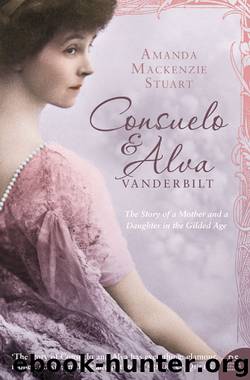
Author:Amanda Mackenzie Stuart [Stuart, Amanda Mackenzie]
Language: eng
Format: epub
ISBN: 978-0-00-744568-4
Publisher: HarperCollins Publishers
Published: 2005-01-01T05:00:00+00:00
The American woman’s suffrage campaign had, by the time Alva joined it in March 1909, stagnated to the point of torpor. The energy of the first phase of the movement, led by Elizabeth Cady Stanton and Susan B. Anthony, which started with the Seneca Falls Convention in 1848, had fizzled out amid bitter disagreements about tactics. One camp favoured securing voting rights for women by way of a federal amendment. By 1908 all serious attempts to push this through had come to a standstill. The second approach was to tackle the issue of female franchise state by state. Wyoming and Utah enacted women suffrage provisions in 1869 and 1870, followed by Colorado in 1893. The most recent state to follow suit had been Idaho and there had been no further progress in the previous twelve years.
The National American Woman Suffrage Association (NAWSA), or ‘National American’, was the only campaigning organisation still active, but it was bedevilled by weak leadership and an amateur approach to political campaigning. Its headquarters were in Warren, Ohio because its treasurer happened to live there. Some key supporters of the National American, particularly Elizabeth Cady Stanton’s daughter Harriet Stanton Blatch, were already deeply frustrated by the time Alva joined. Anna Howard Shaw, president of the National American, now sought to make the best use of her formidable new recruit. She was hoping for a substantial injection of funds and in an effort to encourage Alva’s interest she asked her to act as a delegate to an International Woman Suffrage Alliance Convention in London in April 1909.
Alva was exasperated to find, however, that the general tenor of the conference was placidity and conservatism. Fired up by her new interest, she decided to investigate the working methods of the highly active English suffrage campaign while she was in London. What she found in April 1909 was a British movement broadly divided into two camps. The larger camp was represented by the National Union of Women’s Suffrage Societies (NUWSS), led by Millicent Garrett Fawcett, and was committed to securing votes for women through constitutional methods – an approach similar to that of the National American and supported by Consuelo. A far smaller camp numerically, but one with a high public profile, was represented by a splinter group led by the Pankhursts, whose Woman’s Social and Political Union (WSPU) had split from the main organisation in 1903, frustrated by slow progress and impatience with the failure of the constitutional approach. This group had been nicknamed ‘the suffragettes’ by a journalist in 1906, a name which came to be synonymous with the militant suffragism of the WSPU.
After 1903 the Pankhurst’s WSPU evolved a series of highly publicised tactics which began with ‘mild militancy’ – heckling Liberal politicians, hiding in rooftops and disrupting political meetings and holding rallies. By 1909, however, WSPU tactics were characterised by an undertow of violence and the English campaign was far more divided than in 1908. Widespread criticism of the Pankhursts simply piqued Alva’s interest. ‘I was
Download
This site does not store any files on its server. We only index and link to content provided by other sites. Please contact the content providers to delete copyright contents if any and email us, we'll remove relevant links or contents immediately.
We're Going to Need More Wine by Gabrielle Union(19053)
Pimp by Iceberg Slim(14522)
Bombshells: Glamour Girls of a Lifetime by Sullivan Steve(14081)
The Radium Girls by Kate Moore(12036)
Becoming by Michelle Obama(10032)
Educated by Tara Westover(8060)
The Girl Without a Voice by Casey Watson(7892)
Wiseguy by Nicholas Pileggi(5795)
The Wind in My Hair by Masih Alinejad(5103)
Hitman by Howie Carr(5101)
The Rules Do Not Apply by Ariel Levy(4975)
Hunger by Roxane Gay(4933)
On the Front Line with the Women Who Fight Back by Stacey Dooley(4875)
Year of Yes by Shonda Rhimes(4763)
The Borden Murders by Sarah Miller(4330)
Papillon (English) by Henri Charrière(4278)
Joan of Arc by Mary Gordon(4117)
American Kingpin by Nick Bilton(3894)
Patti Smith by Just Kids(3782)
